
Built and Deployed a Scalable MERN Stack E-commerce Application on AWS

Project Goal
This is a very high-level overview of building and deploying a MERN stack e-commerce application on AWS with scalability. I just finished the project recently on Fiverr.
Overview:
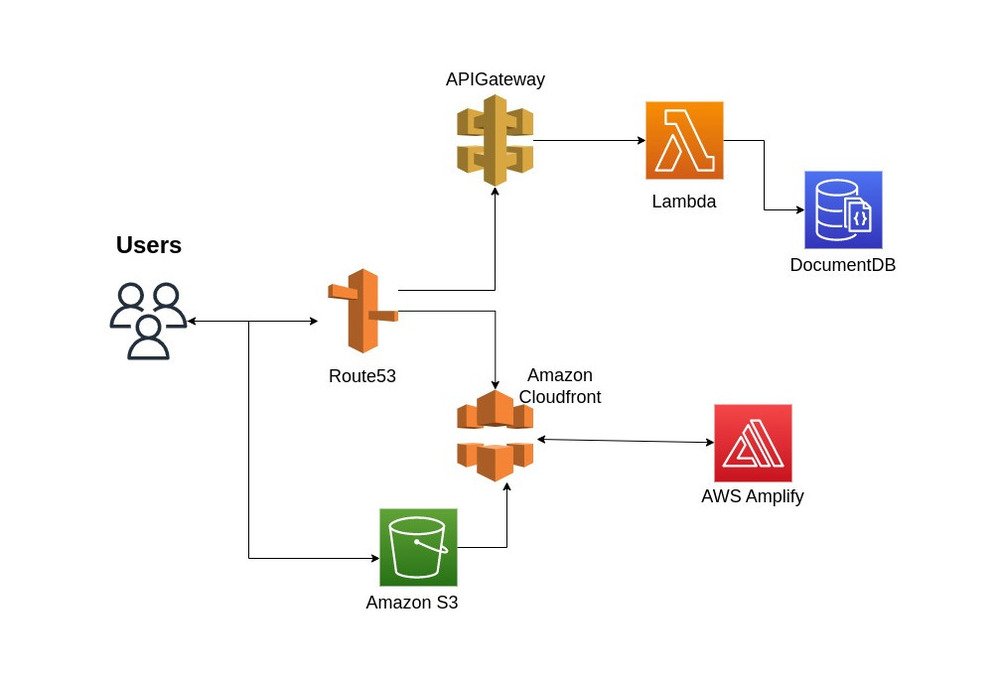
As a freelance developer, I was tasked with building and deploying a scalable MERN stack e-commerce application on AWS. The goal was to create an e-commerce application that could handle a high volume of traffic while being reliable, secure, and scalable. To achieve this, I used several AWS services such as Amazon DocumentDB, AWS Amplify, AWS Lambda, Amazon API Gateway, AWS S3, and CloudFront.
Challenges:
The project presented a few challenges, such as ensuring the security and reliability of the application, integrating a payment gateway for processing transactions, coordinating with other developers working on the project, and efficiently deploying the application on AWS.
Solutions:
To address the security and reliability concerns of the application, I utilized Amazon DocumentDB as the backend database. This allowed me to leverage the scalability and reliability of AWS's database services, ensuring that the application could handle high volumes of traffic without compromising performance. Additionally, I implemented security measures such as encryption of data at rest and in transit.
For the frontend development, I used AWS Amplify to develop and deploy the React application. AWS Amplify provides a comprehensive suite of tools for building and deploying scalable and reliable applications, including authentication, data storage, and API integration. I also integrated a payment gateway to process transactions securely.
For the backend architecture, I used AWS Lambda and Amazon API Gateway. This allowed me to create a flexible and robust backend that could manage the API endpoints efficiently, ensuring that the backend was responsive and could handle high volumes of traffic. To prevent security breaches, I implemented measures such as rate limiting and input validation.
To store user-generated content, such as product images and descriptions, I used AWS S3 as the storage service. This allowed me to store and retrieve data quickly and reliably, ensuring that the application could handle large amounts of data without compromising performance.
Finally, to optimize the application's performance, I used CloudFront as the CDN. CloudFront helped me to improve the application's performance by caching content closer to the users, reducing the latency, and improving the application's responsiveness.
Results:
The project was a success, and the e-commerce application was deployed on AWS with high reliability and scalability. Using AWS services such as Amazon DocumentDB, AWS Amplify, AWS Lambda, Amazon API Gateway, AWS S3, and CloudFront allowed me to build a flexible and robust e-commerce application that could handle high volumes of traffic without compromising performance. The collaboration with other developers working on the project was seamless, and the application was delivered on time and within budget. The integration of the payment gateway enabled secure transactions for customers, increasing trust and improving the user experience.
Conclusion:
Building and deploying a scalable MERN stack e-commerce application on AWS requires expertise and knowledge of AWS services. By utilizing AWS Amplify, Amazon DocumentDB, AWS Lambda, Amazon API Gateway, AWS S3, and CloudFront, I was able to create a reliable, scalable, and performant e-commerce application that met the client's requirements. My expertise in AWS services and MERN stack development enabled me to contribute to the success of the project.

